

Why Are Acrylic Sheets Both Transparent and Impact-Resistant?
Glass is clear. Everyone trusts that. But once safety, weight, and fabrication enter the conversation, its weaknesses show up quickly — cracking, sharp fragments, transport risk, structural load.
Acrylic doesn’t try to imitate glass. It solves the problem in a different way.
Same transparency. Much higher impact tolerance. Lower density. And far more predictable behavior under stress.
So what actually makes this possible? And why does thickness — together with quality inspection — directly determine real impact performance rather than just theoretical strength?
At Apexplast Acrylic Sheet Factory, this question comes up often from engineers, stadium contractors, and display system buyers. The short answer is polymer structure. The long answer is more interesting.
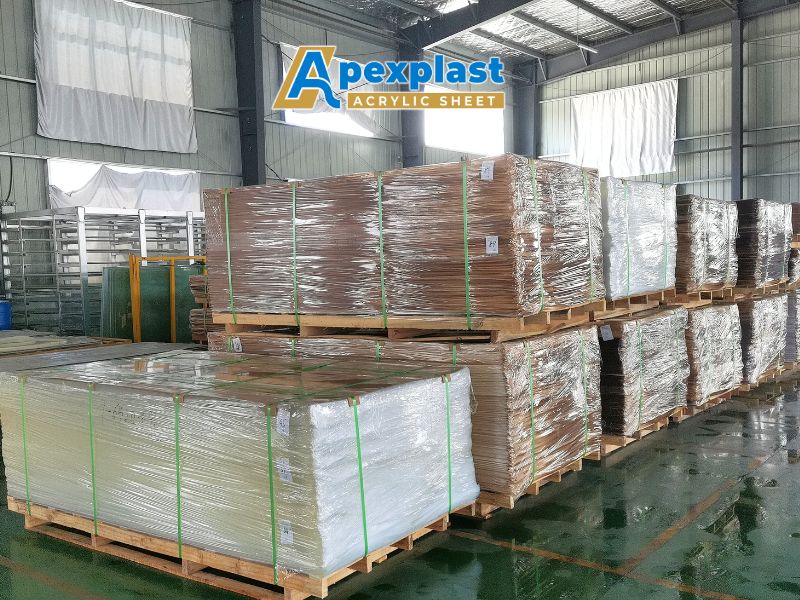
Not Just PMMA — How Structure Becomes Performance
Acrylic, or PMMA, is an amorphous thermoplastic. That word amorphous matters. It means there is no crystal boundary to scatter light. So photons pass through with minimal interruption. That’s where the 92% light transmission comes from.
But optical clarity alone doesn’t explain impact resistance.
The real mechanism sits in the molecular chain:
When external force arrives
→ the chains don’t snap immediately
→ they move
→ energy spreads along the network
Not infinite movement. Not rubber.
Controlled deformation.
That’s the difference between brittle failure and energy absorption.
Cast acrylic has longer molecular chains and lower internal stress. Which is why, under the same thickness, its crack propagation speed is slower than extruded material. In practical terms — it gives you reaction time before failure.
Thickness Is Not Just a Number
In many procurement documents, thickness is treated as a specification line:
6 mm
10 mm
12 mm
But impact resistance is not linear with thickness in real applications. It is tied to three things happening together:
1.Thickness uniformity
2.Internal stress distribution
3.Material purity
If a sheet is nominally 10 mm but fluctuates across the panel, impact energy will always find the thinner zone. That becomes the starting point of fracture.
This is why quality inspection at Apexplast does not stop at thickness measurement. It includes:
· multi-point thickness mapping
· optical distortion scanning
· residual stress testing
· drop-ball or pendulum impact simulation
Because a 12 mm sheet with poor stress control can fail earlier than a well-annealed 10 mm cast sheet.
So in real engineering terms:
Effective impact resistance = usable thickness × structural consistency
Not catalog thickness.
The Quiet Role of Annealing
Acrylic sheets leave the mold with internal tension. Invisible. But under impact, those stress points act like pre-cut lines.
Annealing releases that tension.
Without this step:
· whitening at the edge during machining
· micro-cracks after installation
· unexpected brittle behavior in winter environments
With proper annealing:
·energy travels through the sheet instead of stopping at a weak point
· transparency remains stable over time
This is not a visual upgrade. It’s a structural one.
Why Strength Does Not Destroy Transparency
In many materials, higher strength means fillers, fibers, or crystallization — all of which reduce optical quality.
PMMA takes another route. Its strength comes from chain length and entanglement, not from added reinforcement.
So light transmission stays high.
Haze stays low.
Color remains neutral.
Cast acrylic shows this most clearly in applications where people are close to the surface — arena barriers, museum showcases, panoramic windows. No ripple effect. No optical fatigue.
Impact Resistance in Real Environments
Laboratory numbers are useful, but engineers care about behavior in motion.
A hockey puck hitting rink shielding.
A crowd leaning against a barrier.
A suspended signage system under vibration.
In these cases, failure mode matters more than peak strength.
Tempered glass: strong, then explosive.
Acrylic: deformation, crack warning, structural retention.
That difference changes evacuation safety, maintenance cycles, and liability risk.
Where Thickness Selection Becomes Engineering
Choosing thickness is not about “stronger is safer”. Too thick means:
· higher cost
· more thermal expansion stress
· harder machining
Too thin means energy cannot disperse.
The correct approach starts with:
· impact energy estimation
· span and fixing method
· service temperature
· required safety factor
Then matching this with verified production data, not generic tables.
That’s why project-specific recommendations from the factory matter more than standard catalog values.
A Material That Behaves, Not Just Performs
The real advantage of acrylic is not a single property. It is predictability.
It bends before breaking.
It shows stress before failure.
It keeps transmitting light while carrying load.
That behavior gives designers more freedom and gives contractors more control on site.
Compared with glass — lighter and safer.
Compared with polycarbonate — better optical stability and surface durability.
Not a replacement for everything. But in applications where clarity and human safety meet, it becomes the logical choice.
From Specification to Solution
At Apexplast Acrylic Sheet Factory, thickness tolerance, annealing control, and full-process quality inspection are treated as impact-resistance parameters — not just production steps.
Because for real projects, the question is never:
“How thick is the sheet?”
It is:
“How much energy can this panel safely absorb, and how consistently will it do that over time?”
If your project involves safety glazing, stadium systems, equipment shielding, or structural displays, the discussion should start there.
 *
*
Submit
| 
You can contact us through the following methods: Cell / Whatsapp:+86 17317689345 E-mail : info@apexplast.net Telephone : +86-21-50318416 / 50318414 Add: Room 2212-2216,22nd Floor, No.58 Jinxin Road,Pudong New District, Shanghai, China
|
